
Glossary
| Term | Definition |
|---|---|
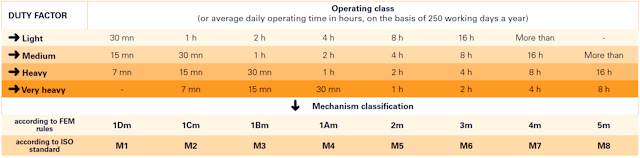
| FEM classification | The European Federation of Materials Handling and Storage Equipment is an association of constructors and experts setting common rules for the design and use of handling equipment, including lifting equipment. To determine the group for your lifting device, winch or block and tackle, three essential parameters are to be taken into account: . Maximum load to be lifted: . Load condition: it determines in what proportions the lifting device is used at maximum load or reduced load.
where :
Thus a distinction is made between four characterised load conditions: Light Lifting devises subjected exceptionally to the maximum load and normally to very light loads. k ≤ 0,5 Medium Lifting devises subjected fairly often to the maximum load and normally to light loads. 0,5 < k ≤ 0,63 Heavy Lifting devises subjected frequently to the maximum load and normally to medium loads. 0,63 < k ≤ 0,8 Very heavy Lifting devises subjected regularly to loads close to the maximum load. 0,8 < k ≤ 1 . Operating class: This is the average operating time per day, on the basis of 250 working days a year. These three parameters thus provide the means for classifying the devices into groups of mechanisms in accordance with this table you can use to determine the group for the lifting device you need :
Our technical sales staff is at your disposal to help you determine the characterised load condition corresponding to your case. |
| Forestry winches | A forestry winch is a type of equipment specially designed to facilitate forestry work. This versatile type of pulling/hauling winch is used to pull or move heavy loads across often uneven terrain, for example during operations such as:
It is therefore essential for loggers, forest operators and forestry professionals. The forestry winches in our catalogue (FORESTBOX range) are fitted with a petrol engine (2- or 4-stroke) for autonomous operation. Compact and lightweight, they are easily transportable, making them ideal for locations that are difficult or even impossible for machinery to access. Their use optimises productivity and improves working conditions, including operator safety (remote operation by pulling the rope, a roll-back brake system preventing the load from moving backwards). In conclusion, the forestry winch is an essential piece of equipment for professionals in the timber industry. However, it is also suitable for fire and breakdown services in remote areas (vehicle recovery, etc.) as well as for the construction sector on demanding sites (pulling cables or pipes, etc.). It combines power, robustness and versatility, whilst reducing the physical strain of tasks carried out manually by operators. |


 CUSTOMER SERVICE